
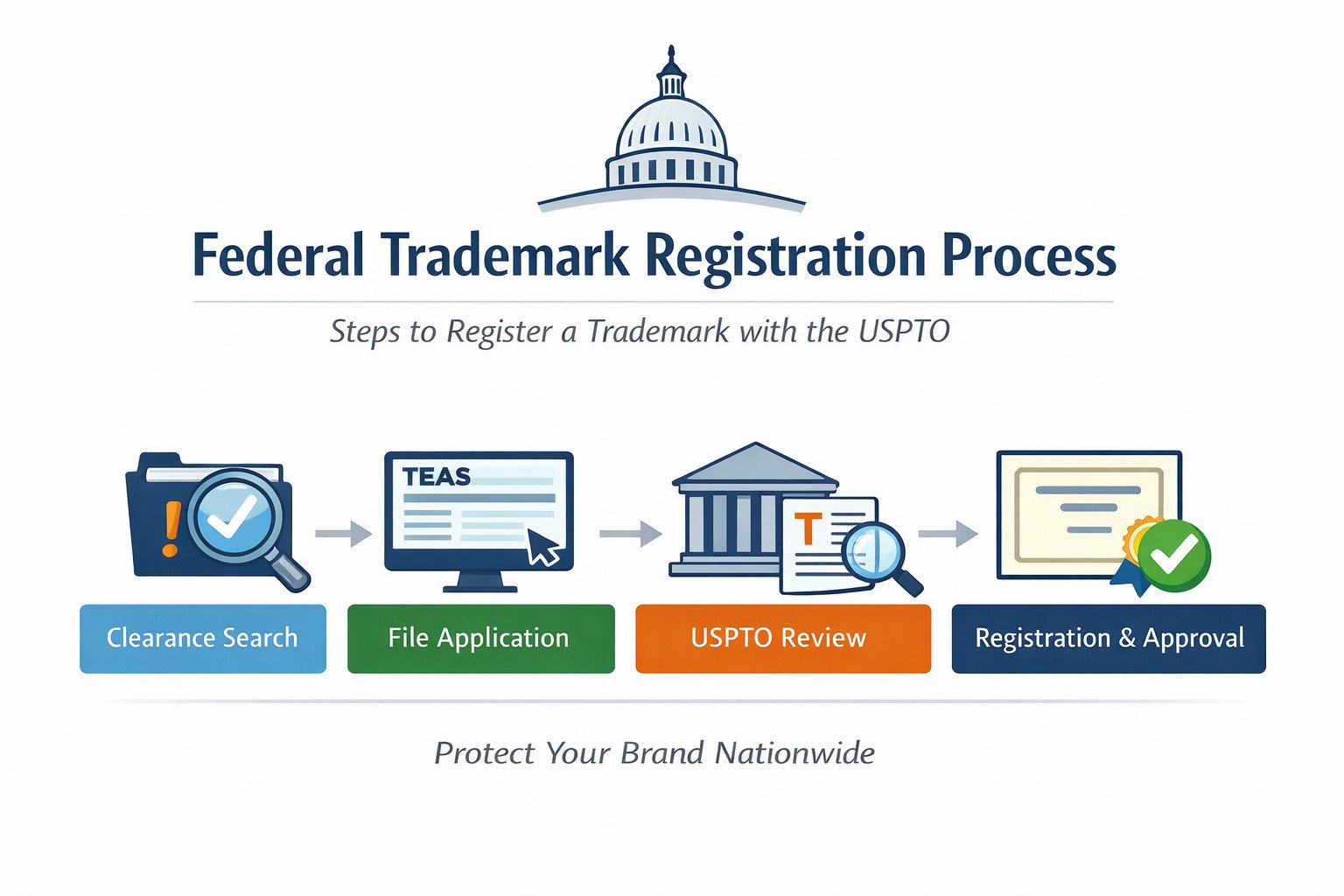

Federal Trademark Registration and the USPTO Review Process
Federal trademark registration is how businesses protect brand names, logos, and service marks nationwide, but the process involves more than submitting an online application. For many business owners, a trademark feels like a box to check. You’ve chosen a name, secured a domain, maybe even launched your product—and now you’re staring at the USPTO website wondering if you can just file the application yourself and move on.
Sometimes you can. But many businesses only discover the real cost of a DIY trademark filing months—or years—later, when fixing mistakes is far more expensive than doing it right the first time.
A federal trademark is not just a form. It is a legal asset tied directly to your brand, your growth strategy, and your ability to enforce your rights. Understanding what’s actually involved before you file can save you time, money, and serious headaches.
Federal Trademark Registration Involves Legal Strategy
A trademark application is deceptively simple on its face. The USPTO provides online tools, drop-down menus, and filing guidance that make the process feel straightforward. What those tools can’t do is assess risk, business fit, or long-term enforceability.
The most common problems I see arise from:
- Choosing a mark that is already too close to an existing trademark.
- Filing under the wrong owner (individual vs. company).
- Using an identification of goods or services that is either too narrow or too broad.
- Submitting specimens that do not meet USPTO requirements.
- Filing without a clearance strategy that considers future expansion.
Each of these issues can result in an Office Action, a refusal, or—worse—a registered trademark that provides little real protection.
Why Clearance Searches Matter More Than Most People Realize
One of the biggest misconceptions is that a quick online search or a scan of the USPTO database is enough to determine whether a trademark is “available.”
Trademark conflicts are based on likelihood of confusion, not exact matches. That means spelling variations, similar sounds, related goods or services, and overlapping markets can all create legal problems—even if the names are not identical.
A proper clearance review looks beyond surface-level results and evaluates risk in context. This is often the difference between a trademark that supports your business and one that quietly exposes you to rebranding costs or legal disputes down the road.
Filing Errors Can Lock You Into Bad Outcomes
Once a trademark application is filed, certain choices are very difficult—or impossible—to undo.
For example:
- You generally cannot broaden your goods or services later.
- You may need to start over if the wrong entity owns the application.
- Poorly drafted descriptions can limit enforcement or invite challenges.
- Incorrect specimens can delay registration for months.
While USPTO filing fees may appear modest, the real cost comes from refiling, responding to avoidable Office Actions, or discovering that your “registered” trademark doesn’t actually protect how you use your brand.
Why Working With a Trademark Attorney Is Different
Because federal trademark registration defines the scope of your legal rights, early filing decisions can affect enforcement options years later.
A trademark attorney’s role is not just to submit paperwork. It is to:
- Align your trademark strategy with your business goals.
- Identify legal risks before you invest in branding.
- Draft applications with enforcement and longevity in mind.
- Guide you through USPTO correspondence and deadlines.
- Help you avoid costly missteps that don’t show up until later.
Federal trademark registration is often part of a broader brand protection strategy; learn more about our trademark and copyright services here. As attorneys with business and compliance backgrounds, we approach trademarks as both legal protections and business assets. That means thinking not just about registration, but about how your brand will function, scale, and be defended in the real world.
When It Makes Sense to Get Help Early
For businesses that rely on their brand as a core asset, federal trademark registration is often a decision best made with a clear understanding of both legal and practical risk. If your brand is central to your business, if you plan to grow beyond your local market, or if you want confidence that your trademark will actually protect you, getting legal guidance early is usually the most cost-effective choice.
Trademark law rewards planning. Fixing problems after the fact is almost always more expensive.
Ready to Protect Your Brand the Right Way
If you’re considering a federal trademark—or you’ve already filed and have questions—we’re happy to help you evaluate next steps. Thoughtful trademark strategy now can prevent expensive surprises later. Contact us today to learn how our team can provide the tailored legal advice and strategies you need to protect your business and build trust with your customers.